Navi Loan Overdue? What Happens After a Missed EMI
Your CIBIL score updates when lenders report to the bureau. Learn the timeline, delays and how to speed it up...
Most people treat a missed EMI like missing one local train. You will catch the next one, and nothing much changes. In reality, it is closer to missing the last train of the night. The delay is small, but everything planned after it shifts: the ride home, the cost, the time. A missed EMI sets off a chain in the same way, and knowing the chain helps you step in before it gets expensive.
Here is exactly what follows a missed Navi EMI, based on Navi's published charge schedule and RBI rules.
Already missed a Navi EMI? Do not wait for the penalty clock to run. Talk to our to understand your overdue amount and your options today.
Who is actually behind your Navi loan
Navi loans are issued by Navi Finserv Limited, an RBI-registered NBFC. Some of these loans are co-lent with partner lenders, so the exact charges depend on your loan agreement and Key Fact Statement (KFS). Everything below describes the standard Navi structure. Always confirm against your own KFS.
Day 0 to Day 7: the quiet window
If your EMI is on e-NACH auto-debit and your balance is short, the debit fails. Your bank may charge its own bounce fee for the failed mandate, separate from anything Navi charges. Navi says you will start getting SMS, email and phone reminders.
Navi's penalty charge does not start in this window. It begins on day 8. Do not treat this as a free pass, though, because lenders report to credit bureaus on a fixed schedule (more on that below).
Day 8 to Day 22: the penalty clock
Since April 2023, Navi charges a single "EMI penalty charge" for late payment. For dues from August 30, 2024, it works like this:
Day 8: 5% of the overdue EMI
Day 15: another 5%
Day 22: another 5%
The total is rounded down (to the nearest ₹100 for overdue EMIs above ₹2,000) and includes taxes.
Example using Navi's own illustration, a ₹5,500 EMI with no payment: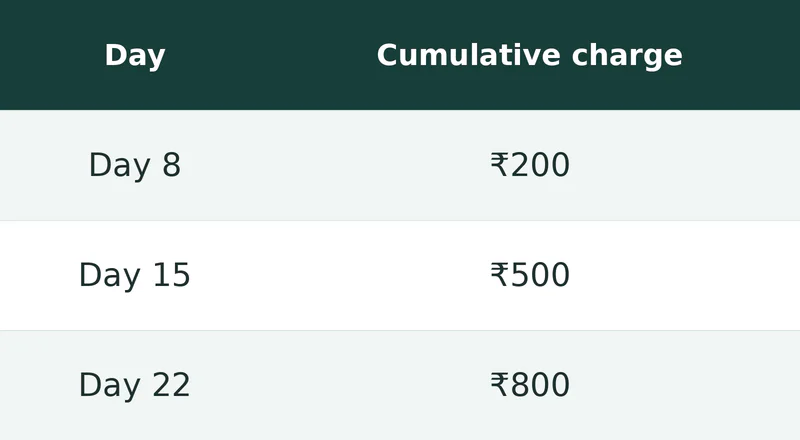
So a ₹5,500 EMI becomes ₹6,300 in three weeks, about 14.5% more, for a delay of under a month. If you pay part of it, later charges are calculated only on what is still overdue. Pay ₹1,000 on day 10, and the day-15 charge is 5% of ₹4,500.
There is one reassuring rule. Under RBI's fair lending norms on penal charges, lenders cannot add penalty as extra interest or charge interest on top of it. Navi's own interest rate policy states that penalty charges are not capitalised. The charge grows in steps, not through interest on interest.
Older loans differ. EMIs due before April 2023 or before August 30, 2024 follow earlier schedules, so check your loan agreement.
Your credit report: faster than most people assume
Lenders report borrower data to credit bureaus such as CIBIL, Experian, Equifax and CRIF. RBI moved lenders from monthly to fortnightly reporting in January 2025.
Think of it as a report card that used to arrive once a term and now arrives every week. A late payment no longer waits long to show up, so do not rely on any informal "grace period" with the bureaus. Bureaus record days past due, and the impact on your score depends on your overall profile and how long the delay lasts. A longer delay hurts more, and even after you pay, the late record stays visible to future lenders for years.
Day 30 to 90: recovery steps begin
Navi says that for overdue accounts it may send legal notices and involve tele-calling and field collection agents. Recovery contact is governed by RBI's fair practice norms:
Calls only between 8 AM and 7 PM
No threats, abuse, intimidation or public shaming
Agents must behave professionally and identify themselves
If an agent crosses these lines, you have the right to complain.
Beyond 90 days: NPA and legal routes
When an account stays overdue for more than 90 days, RBI norms classify it as a Non-Performing Asset (NPA). Navi has said that in persistent cases the matter can escalate to legal action, such as a suit to recover the amount. Where your agreement includes an arbitration clause, the lender can also use that route.
The kirana khata effect
Imagine a local kirana shop where your monthly bill is ₹5,500. You skip it once. The shopkeeper adds a late fee, starts reminding you daily, and eventually tells the neighbourhood you are not paying. You lose the credit that once let you shop without worry.
A missed EMI works the same way. Say you miss three EMIs of ₹5,500. That is ₹16,500 in overdue instalments, plus penalty charges of up to ₹800 on each missed instalment under the schedule above. The money problem grows, but the bigger damage is the record that follows you into your next loan or credit card application.
What to do right now
Pay as early as you can. Even a partial payment reduces the base on which later penalties are calculated.
Tell Navi before the due date if you can see trouble coming. Use the Help section of the app. Early contact leaves more room for a workable plan.
Do not ignore calls and messages. Silence only speeds up escalation. Be honest about your situation and your timeline.
Avoid borrowing from unverified apps to pay the EMI. It usually trades one overdue loan for a costlier one.
Read your KFS and loan agreement. Your exact penalty structure must be disclosed there.
Be careful with settlement. A settled account is not reported the same way as a fully closed one, and it can affect future borrowing. Read our guide on Navi loan settlement and what happens if you can't repay your loan before you agree to anything
Check your credit report a few weeks after clearing dues to confirm it was updated correctly.
Not sure where you stand or which option fits your situation? We can help you understand your overdue amount, your rights, and your next steps.
If you face harassment or a wrong charge
Raise a complaint with Navi through the app or website first. If it is not resolved, or you do not get a reply within 30 days, you can escalate to the RBI Integrated Ombudsman through the RBI's online complaint portal. Keep records of call dates, messages and screenshots.
The bottom line
A missed EMI is not an emergency in the first hours, but it is a countdown: a quiet first week, then penalty steps on days 8, 15 and 22, faster credit reporting, and recovery action that increases with time. The first missed payment is the best moment to act, because every stage after it costs more in money and in credit history.
If an overdue loan is weighing on you, we can help you understand your options and take the next step with confidence.
Planning to apply for a loan or credit card soon?
*This content is for informational purposes only and does not constitute legal or financial advice.
Frequently Asked Questions
Will one missed EMI affect my credit score?
It can. Lenders report to bureaus weekly from July 1, 2026, so delays show up quickly. The size of the impact depends on your overall credit profile and the length of the delay.
What happens if I do not pay my EMI for over 90 days?
The account is classified as an NPA, collection efforts increase, and the lender may pursue legal remedies such as a suit or arbitration where applicable.
Can I pay my overdue EMI partially?
Yes. Partial payment reduces the overdue base, and Navi's schedule calculates later charges on the remaining overdue amount. Clearing the full overdue amount is what brings the account current.
Credfix
When debt feels overwhelming, we help you understand what comes next. Get practical guidance on missed EMIs, recovery calls, legal notices, settlement options, and your rights - explained simply, so you can make informed decisions.
Visit SiteEvery loan has a way out. Find yours.
Know your options. Take control.