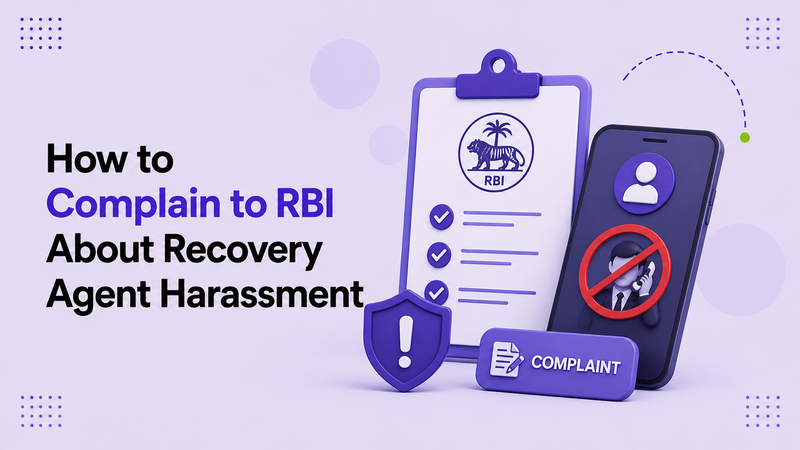
How to Complain to RBI About Recovery Agent Harassment
That 9 PM recovery call? It's illegal. Here's the RBI rule most borrowers don't know exists, and exactly how to make harassment stop for good...
Missing an EMI does not strip you of your rights as a citizen. Yet every day, thousands of borrowers across India get calls at 10 PM, threats of "police action," or agents showing up at their workplace to create a scene in front of colleagues. If this sounds familiar, you are not powerless. The Reserve Bank of India has built a formal, free, and legally binding grievance system exactly for this problem, and most people never use it simply because nobody has explained it clearly. This guide does.
Get help documenting what's happening and filing your complaint the right way, starting today.
First, Know What Actually Counts as Harassment
Think of the RBI's Fair Practices Code as a fence around a construction site. Recovery agents are allowed to work inside that fence, calling you, reminding you, even visiting you, but the moment they step outside it, the bank is liable, not just the agent.
Under the Code, agents can only contact you between 8 AM and 7 PM. A call at 9:45 PM about your EMI is already a violation, no matter how "polite" it sounds. Agents also cannot use threats, abusive language, or intimidation of any kind, including vague ones like "we'll make sure everyone in your office knows." They are not allowed to contact your family, friends, or employer to discuss your debt; the only exception is if you have become genuinely unreachable, in which case they may contact a third party solely to locate you, never to discuss the loan itself. Publicly shaming a borrower, visiting without notice, or misrepresenting legal authority (for example, falsely claiming they can have you arrested for a personal loan default) are all clear violations.
Note: these steps apply to the current rules. RBI has already finalized an updated recovery framework effective January 1, 2027, tightening things further. See our breakdown here: [RBI's New Loan Recovery Rules: What They Really Mean For You].
Step 1: Document Everything Like It's a Flight Recorder
Airlines do not investigate a crash based on memory. They pull the black box because a recorded, timestamped account beats anyone's recollection. Treat your harassment complaint the same way.
From the very first incident, keep a simple log: date, time, the agent's name (or number if unnamed), what was said, and how it made you feel or what it disrupted. Save call recordings where possible, screenshot every abusive SMS or WhatsApp message, and note down the names of any witnesses (a colleague who overheard a threatening call, for instance). Under RBI's 2026 directions, banks are increasingly expected to digitally record recovery calls themselves; you can formally request this recording from the bank, and its absence becomes part of your complaint if they cannot produce it.
This log is not paperwork for its own sake. It is what turns "an agent was rude to me" into "on 14th August at 9:52 PM, agent X threatened to visit my office," which is the kind of specific, evidenced claim that regulators and banks actually act on.
Manually logging every call, screenshot, and date is exactly the kind of thing you forget to do when you're stressed.
Let Credfix build your evidence log for you, so nothing gets missed when it matters most.
Step 2: Complain to the Bank or NBFC First (This Step Is Mandatory)
Here is a detail most borrowers miss: you cannot go straight to the RBI Ombudsman. You must first complain to the lender itself, in writing, addressed to its Principal Nodal Officer or Grievance Redressal Officer.
Send an email with a clear subject line such as "Formal Complaint, Recovery Agent Harassment, Loan Account [Number]" and, ideally, follow up with the same letter by registered post to the bank's registered address. Attach your evidence log, recordings, and screenshots. Under the Fair Practices Code, the bank is directly and fully responsible for the conduct of any recovery agent acting on its behalf, so this is not you asking the bank for a favour; it is you holding them accountable for their own outsourced staff.
Written complaints matter because banks know regulators are watching them, and a documented paper trail is often the exact moment harassment quietly stops. It also starts the legal clock: the bank now has 30 days to respond.
Step 3: Escalate to the RBI Ombudsman if the Bank Fails You
If 30 days pass with no response, or the bank's reply is unsatisfactory, or they simply reject your complaint, you can escalate to the RBI Ombudsman under the Reserve Bank Integrated Ombudsman Scheme (RB-IOS), 2026, which came into force on 1 July 2026.
You have three ways to file, all completely free:
Online: cms.rbi.org.in, the Complaint Management System, where you fill in details and attach your evidence in minutes
Email: crpc@rbi.org.in
Post: Centralised Receipt and Processing Centre (CRPC), Reserve Bank of India, Central Vista, Sector 17, Chandigarh - 160017
For guidance on the process (not to file a complaint directly), you can also call the RBI's toll-free helpline at 14448.
You get 90 days from the date the bank's reply reaches you, or from the date the 30-day response window lapses, to file with the Ombudsman. This window is tighter than the older scheme's one-year limit, so treat it like a boarding gate that closes, not a rolling deadline.
Once filed, the RBI contacts the bank, demands a written response, and may attempt a conciliation meeting to resolve things quickly. If that fails, the Ombudsman can pass a formal, binding award. Under RB-IOS 2026, the Ombudsman can award compensation of up to ₹30 lakh for financial or consequential loss, and up to ₹3 lakh separately for the mental anguish, harassment, and time or expense the borrower has suffered. Either the bank or you can appeal the decision to RBI's Appellate Authority within 30 days if genuinely unsatisfied.
Don't let paperwork be the reason you miss out on what you're owed. Get guided through every step of the way with Credfix.
When to Also Involve the Police
If a recovery agent has made a physical threat, damaged property, or attempted to seize an asset outside the legal SARFAESI process (for instance, a roadside vehicle seizure without prior notice), that is not just a banking grievance, it is potentially a criminal matter. File a police complaint citing criminal intimidation, alongside your RBI complaint; the two run in parallel and address different harms.
A Quick Story to Anchor This
Take Ramesh, a small business owner two EMIs behind on a personal loan. For two weeks he received calls after 10 PM, and one agent threatened to "create a scene" at his office if he did not pay by Friday. Ramesh started logging every call, screenshotted three threatening messages, and emailed a formal complaint to the bank's nodal officer. The bank did not respond within 30 days. Ramesh filed on cms.rbi.org.in, attaching his log and the unanswered email as proof. Within weeks, the bank was compelled to respond formally, the harassment stopped immediately, and Ramesh was later awarded compensation for the distress caused. Nothing about his outstanding loan changed except how it was collected, which is exactly the point of this system.
The Bottom Line
Owing money is a financial obligation. It is never a licence for anyone to threaten, humiliate, or intimidate you. RBI has built a genuinely free, borrower-friendly system to enforce that line: document everything, complain to the lender in writing, wait 30 days, then escalate to the Ombudsman within 90 days if needed. Most borrowers never get this far simply because they never start the first step. Start it today, and let the paper trail do the rest.
Document, complain, escalate, all in one place, so harassment stops being something you endure and starts being something you end.
Disclaimer: This article is for general information and reflects rules effective under RB-IOS 2026. For advice on your specific loan account, consult your lender's grievance officer or a qualified professional.
Frequently Asked Questions
What counts as harassment by a bank's recovery agent?
Under RBI's Fair Practices Code, agents can only call between 8 AM and 7 PM, cannot use threats or abusive language, cannot contact your family or employer to discuss the debt, and cannot publicly shame you or misrepresent their legal authority.
Can I complain directly to the RBI Ombudsman?
No. You must first send a written complaint to your bank or NBFC's Grievance Redressal Officer. Only if the bank doesn't respond within 30 days, or gives an unsatisfactory response, can you escalate to the Ombudsman.
How do I file a complaint with the RBI Ombudsman?
You can file online at cms.rbi.org.in, by email at crpc@rbi.org.in, or by post to the Centralised Receipt and Processing Centre in Chandigarh. All three methods are free.
What is the deadline to escalate to the RBI Ombudsman?
You have 90 days from the date the bank's reply reaches you, or from the date the 30-day response window lapses, to file with the Ombudsman under RB-IOS 2026.
How much compensation can the RBI Ombudsman award?
Up to ₹30 lakh for financial or consequential loss, and up to ₹3 lakh separately for mental anguish, harassment, and the time or expense the borrower incurred.
What evidence should I keep if an agent harasses me?
A dated, timestamped log of every incident: the agent's name or number, what was said, call recordings, screenshots of abusive messages, and names of any witnesses.
When should I also file a police complaint?
If an agent makes a physical threat, damages property, or attempts an illegal asset seizure outside the SARFAESI process, file a police complaint for criminal intimidation alongside your RBI complaint.
Credfix
When debt feels overwhelming, we help you understand what comes next. Get practical guidance on missed EMIs, recovery calls, legal notices, settlement options, and your rights - explained simply, so you can make informed decisions.
Visit SiteEvery loan has a way out. Find yours.
Know your options. Take control.