Got a Legal Notice from mPokket? Here's What It Actually Means
No, you're not going to jail. No, they can't call your mom. Here's what an mPokket legal notice really means...
A legal notice can feel like the scariest letter you've opened. Words like "default," "legal proceedings," and "within 7 days" are designed to make you panic. Most people either pay whatever is demanded immediately, often into an account they haven't checked, or ignore it and hope it disappears. Both reactions can hurt you.
Don't reply to anything until you know what's real.
Credfix checks your notice, your loan status, and your options in minutes, so you're never guessing with money or your credit score on the line.
What Is an mPokket Legal Notice, Exactly?
mPokket is a lending app that mostly serves students and young professionals with small-ticket loans. Like most lending apps, it doesn't lend its own money directly; loans are funded by partner NBFCs (non-banking financial companies), with mPokket handling the platform and servicing.
When a loan stays unpaid past its due date, usually after several reminder calls and messages have already gone unanswered, mPokket, its lending partner, or a law firm acting on their behalf may send a legal notice. It typically states your loan account number and outstanding amount, that you've "defaulted," a demand to pay within a fixed number of days, and a warning that they "may initiate legal proceedings" if you don't respond.
Pay attention to that phrase: "may initiate." A legal notice is a pre-litigation step, a formal warning and demand. It is not a filed case, not a court summon, and not a warrant.
Is the Notice Real or Fake?
Fake "legal notices" from aggressive recovery agents are common in the loan-app space. Run through this checklist before you react:
Who sent it? A genuine notice comes from mPokket, its lending partner NBFC, or an advocate or law firm with a verifiable name, address, and bar enrolment number. Search for the firm independently online, and call the number listed on the firm's own website, not the number printed on the notice.
Where is the money supposed to go? A real notice directs you to repay through the mPokket app or the lender's official channels. If it asks for a personal UPI ID or a "settlement portal" link over WhatsApp, treat that as a scam.
What's the tone? Genuine legal notices are formal and dry. Threats of arrest, police visits, or "your contacts will be informed today" are intimidation tactics, not language a lawyer actually uses.
Does the amount match? Check your outstanding balance directly in the mPokket app. A wildly different figure is a red flag.
Is the deadline reasonable? Real notices give you days or weeks to respond, not hours.
Cross-check with mPokket directly. Email their official grievance officer and ask them to confirm the notice was genuinely issued on their behalf.
Still unsure if this notice is genuine?Credfix helps you verify your loan details and next steps in minutes.
Even if a notice came from an overzealous recovery agency rather than an actual lawyer, don't dismiss the underlying issue. The loan is still overdue and still being reported to credit bureaus regardless of how the notice was worded.
What Can Actually Happen If You Don't Pay
It helps to separate fear from fact here.
What cannot happen: You cannot be arrested or jailed for failing to repay a loan; this is a civil matter, not a criminal offence. Police will not come to your house over a default. Agents cannot legally threaten, abuse, or shame you to your family, friends, or employer, and RBI's fair-practices and digital-lending rules explicitly prohibit this. They also cannot pressure you into selling belongings or taking another loan to pay this one.
What can happen: Collection calls will continue, and the outstanding amount keeps growing with interest and penalties. Your account gets reported as overdue or in default to credit bureaus like CIBIL, Experian, Equifax, and CRIF, which damages your credit score for years. Your credit limit on the app gets blocked. In principle, the lender also has the right to file a civil recovery suit or invoke arbitration under the loan agreement. For small-ticket loans this is uncommon, since litigation often costs more than the loan itself, but it remains the lender's legal right, and a notice is the required first step before it. If your loan was linked to a post-dated cheque or NACH mandate that bounced, separate cheque-bounce proceedings can also apply; check your loan agreement to be sure.
The honest summary: the realistic risks are credit damage and ongoing collection pressure, not jail. That doesn't mean the notice is safe to ignore. It means you should respond from a position of knowledge rather than fear.
Not sure where you stand right now? Track your loan status, repayment options, and credit impact in one place.
Four Things Not to Do
Don't ignore it. Silence can be read as unwillingness to pay, and a written reply protects you and creates a paper trail.
Don't pay into any account that isn't mPokket's official channel, not even a small "goodwill" payment.
Don't take a new loan from another app to pay this one off. This is exactly how one overdue loan turns into five.
Don't sign or send anything you don't fully understand, including "settlement letters" agents forward over WhatsApp.
Your Next 7 Days: A Step-by-Step Plan
Day 1: Read the notice properly: who sent it, the amount claimed, the deadline, and what they're asking. Screenshot everything and run it through the verification checklist above.
Day 2: Pull together your records: loan sanction letter, repayment history, bank statements showing payments made, and a log of every collection call and message, with dates and numbers. Save any evidence of abusive calls or contact outside permitted hours.
Day 3: Decide honestly what you can realistically pay each month. Pay in full if you can, the cleanest path since the account eventually shows "Closed"; ask for a restructured plan, spreading the amount as EMIs, if you can pay but not all at once; or propose a one-time settlement (OTS) if you genuinely cannot repay in full. A settled account shows as "Settled" rather than "Closed," which isn't as good as a clean closure but is far better than an ongoing default or write-off.
Days 4-5: Reply in writing, before the deadline, to both the sender and mPokket's grievance officer. Acknowledge receipt, state your position, and propose a concrete plan:
"I acknowledge receipt of your notice dated [date] regarding loan account [number]. I do not dispute that the loan is outstanding. Due to [brief reason], I have been unable to repay on schedule. I intend to resolve this and request that you consider [a repayment plan of ₹___ per month starting ___ / a one-time settlement of ₹___ payable by ___]. Please share the revised terms in writing, and direct all further communication to this email address in compliance with RBI's fair-practices guidelines."
Adjust the reason and offer to fit your situation. Never admit to an amount you haven't verified, and never promise a payment you can't make.
Days 6-7: Follow up and keep documenting. If agents keep calling despite your written reply, that itself is a legitimate grievance. Raise it first with mPokket's grievance redressal officer, then, if unresolved, escalate to the RBI's Complaint Management System (cms.rbi.org.in) or the Sachet portal for digital-lending complaints.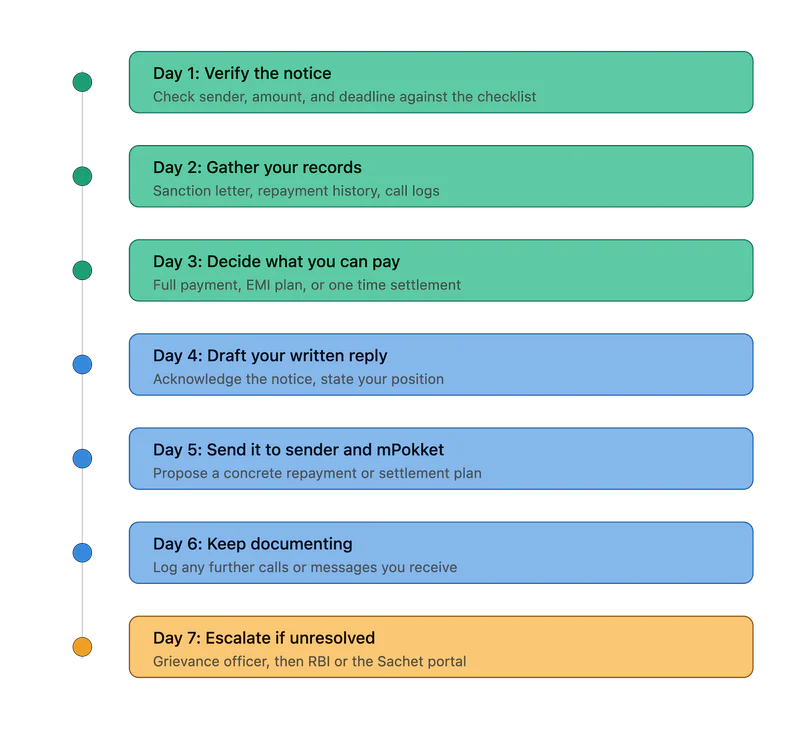
Your Rights as an mPokket Borrower
Whether or not you're currently overdue, RBI's Fair Practices Code and Digital Lending Guidelines apply to mPokket and its partners at all times. You're entitled to no collection calls before 8 AM or after 7 PM, no abuse or repeated pressure calling, no contact with friends, family, or colleagues to shame you (loan apps are also barred from harvesting your contact list for this), proper identification from any agent along with their authorisation letter on request, a clear breakdown of what you owe, and a named grievance officer who must respond within the RBI-mandated timeline. If they don't, escalate to the RBI directly.
If any of these protections are being violated, document it. It strengthens your position in any negotiation and gives you grounds for a formal complaint.
Dealing with a legal notice is easier with the right information at hand. Credfix keeps your loan status, repayment plans, and credit score checks in one app.
Frequently Asked Questions
Will mPokket actually file a court case against me?
They can, in principle, but for small-ticket loans it's rare, since litigation usually costs more than the loan.
Can I go to jail for not paying mPokket?
No. Non-repayment is a civil matter in India. Any threat of arrest or jail is intimidation with no legal basis.
Can mPokket recovery agents come to my house?
Field visits are permitted within RBI norms: during permitted hours, with proper identification, and without intimidation. Agents cannot force entry, take belongings, or threaten you.
Can mPokket call my family or contacts?
No. Contacting third parties to pressure or shame you violates RBI guidelines. Report it to mPokket's grievance officer, and to the RBI if it continues.
I received the notice only over WhatsApp. Is it still valid?
The channel alone doesn't make it fake. Verify the sender's identity and payment details using the checklist above.
Can I settle my mPokket loan for less than the full amount?
Often, yes, especially once 90 days overdue. It will then be reported as "Settled." Get the terms in writing, and obtain a No Dues letter once paid.
What happens to my CIBIL score?
It's already being affected by the overdue status. Repaying in full ("Closed") is best, settlement is a middle ground, and an ongoing default or write-off is worst. Resolving the account, one way or another, is what starts the recovery.
How long do I actually have to reply?
Whatever the notice states, usually 7 to 30 days. Reply before the deadline even if you can't pay yet; a written response proposing a realistic plan protects you.
Credfix
When debt feels overwhelming, we help you understand what comes next. Get practical guidance on missed EMIs, recovery calls, legal notices, settlement options, and your rights - explained simply, so you can make informed decisions.
Visit SiteEvery loan has a way out. Find yours.
Know your options. Take control.