Can't Repay Your mPokket Loan? Here's What You Can Do
Can't repay your mPokket loan? Learn the real path between restructuring and settlement, and how to negotiate without losing leverage...
There's a specific kind of panic that sets in when you realize you genuinely cannot make your next loan repayment. Most borrowers in that position do one of two things: they go silent and stop opening the app, or they panic-call, ready to agree to anything just to make the anxiety stop.
Neither is the right move. There's a structured path between "pay in full" and "default and disappear," and understanding where you sit on it changes what your next step should actually be.
Not sure where you fall on that spectrum? Credfix helps you figure out your situation and the right next step, download the app and get clarity.
First, Figure Out Which Kind of "Can't Pay" You're In
Think of repayment ability on a spectrum, not a binary:
Temporary cash crunch - you'll have the money in a few weeks, just not on the due date.
Reduced but real income - you can pay something every month, just not the full EMI.
Genuine, provable hardship - job loss, medical emergency, or income disruption that makes any meaningful repayment impossible for the foreseeable future.
Each of these has a different correct response. Treating a temporary crunch like a full-blown settlement case wastes leverage you didn't need to give up. Treating a genuine hardship like a minor delay just lets penalties and credit damage accumulate while you wait for a recovery that may not come soon enough.
If It's Temporary: Talk to Mpokket Before the Due Date, Not After
If you can see a missed payment coming, the best move is to contact them before the due date, not after. Once a payment is overdue, additional charges and penalties may start applying, and there’s little you can do to change those. Reaching out early, even a day before, gives you a better chance to discuss your situation and understand your options before the account moves further into overdue status.
If You Can Pay Something: Ask About Restructuring First
Restructuring - extending your tenure or adjusting your EMI amount so the monthly payment becomes manageable. It is typically the first thing a lender offers, and it's worth understanding what it actually does: it lowers your monthly outgo, but because interest keeps accruing over a longer period, your total repayment amount usually increases. It's a genuine tool for a genuine cash-flow problem, but it is not designed to reduce what you ultimately owe.
Importantly, and this is where a lot of borrowers get frustrated: Mpokket, like most lenders, will almost always offer restructuring before it will offer a real settlement. That's not a stalling tactic, it's standard practice across the industry to protect the loan's recoverable value for as long as reasonably possible.
If It's Genuine Hardship: One-Time Settlement (OTS)
A One-Time Settlement is a formal, negotiated agreement where the lender accepts a reduced lump-sum payment as full and final closure of your outstanding debt, instead of the complete amount, including accumulated penalties and interest. This exists specifically for borrowers who can demonstrate they cannot repay in full, and it is a legitimate, RBI-recognized resolution path, not a loophole.
Two things are worth understanding clearly before you pursue one:
Settlements are rarely offered early. Lenders, generally will not entertain a genuine principal-reducing settlement while your account is still in its early overdue stages (what's classified as SMA-0 or SMA-1, roughly the first 60 days past due). At that stage, you'll typically be offered restructuring instead. Meaningful settlement discounts tend to become available only once an account has aged significantly into default, generally well past the 90-day NPA mark, when the lender's own calculus shifts toward recovering something rather than holding out for everything.
Settling affects your credit file differently than paying in full. When a settled loan is reported to credit bureaus, it's typically marked as "Settled" rather than "Closed" or "Paid in Full." This distinction matters for future lenders assessing your creditworthiness. A "Settled" tag signals that you didn't repay the full contracted amount, and it generally remains visible on your credit report for years. It's also worth knowing: a "Settled" status, while it does affect your score, is still viewed more favourably by future lenders than an account that was never resolved at all.
Settlement decisions have long-term consequences. Credfix walks you through whether OTS is right for you and how to approach it.
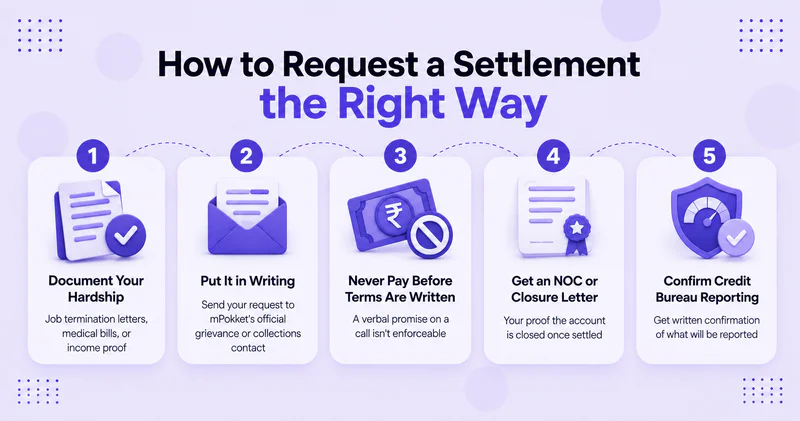
How to Request a Settlement the Right Way
Document your hardship. Job termination letters, medical bills, or income proof, anything that substantiates genuine inability to pay, not just unwillingness.
Put your request in writing, addressed to Mpokket's official grievance or collections contact, stating your outstanding amount and your proposed settlement figure.
Never pay before you have the settlement terms in writing. A verbal agreement over a collection call is not enforceable, and any payment made without documented terms may simply be treated as a part-payment against the full amount, not a settlement.
Get a No Objection Certificate (NOC) or closure letter once the settlement amount is paid. This is your proof the account is closed and shouldn't be pursued further.
Request written confirmation of what will be reported to credit bureaus, so you're not surprised by the "Settled" tag later.
Getting each of these steps right matters. Credfix helps you put together your settlement request the right way, so nothing costs you leverage later.
Mistakes That Quietly Cost Borrowers Leverage
Going silent. An unreachable borrower gets escalated faster than one who's actively communicating, even if that communication is "I can't pay right now, but here's why."
Agreeing to informal, verbal settlement promises. If it isn't in writing, it isn't binding, for either side.
Settling too early, when a lender's actual offer is usually weakest, before the account has aged enough for a genuine reduction to be on the table.
Assuming a missed EMI is a criminal matter. It isn't. This is a civil debt issue; no lender can have you criminally prosecuted simply because a loan repayment is overdue.
Assuming a missed EMI is a criminal matter. It isn't. This is a civil debt issue; no lender can have you criminally prosecuted simply because a loan repayment is overdue. (If you've already received a legal notice and want to understand what it actually means, read this guide.)
While You Negotiate, the Clock on Charges Still Runs
It’s worth remembering that penal charges and interest can continue accruing while you’re figuring out your next step. These charges are generally calculated at the loan’s original rate, on a simple, non-compounding basis.
So, while you negotiate, the clock doesn’t stop.
The sooner you understand your options and take action, the better you can manage the amount you ultimately have to repay. Don’t let uncertainty add to the cost of an already difficult situation.
Disclaimer: This article reflects Mpokket Financial Services Pvt. Ltd.'s Penal Charges Policy (effective January 2025), RBI's Fair Lending Practice circular on penal charges (August 18, 2023), and RBI's asset classification and Fair Practices Code norms, as of September 2026. Settlement terms, credit reporting practices, and charges are subject to change. Always confirm current terms directly with Mpokket and get any agreement in writing.
Frequently Asked Questions
What should I do if I know I can't pay my mPokket EMI on time?
Contact mPokket before the due date, not after. Reaching out early gives you a better chance to discuss your situation before additional charges and penalties apply and the account moves further into overdue status.
What's the difference between loan restructuring and a One-Time Settlement (OTS)?
Restructuring extends your tenure or adjusts your EMI so the monthly payment is more manageable, but your total repayment usually increases since interest keeps accruing. OTS is a negotiated agreement where the lender accepts a reduced lump-sum payment as full and final closure of your debt. Lenders typically offer restructuring first and reserve settlement for accounts with genuine, provable hardship.
When will mPokket actually offer a settlement?
Rarely in the early overdue stages (SMA-0 or SMA-1, roughly the first 60 days past due), when restructuring is usually offered instead. Meaningful settlement discounts tend to become available only once an account has aged well past the 90-day NPA mark.
Does settling a loan affect my credit score differently than paying it off in full?
Yes. A settled loan is typically marked "Settled" on your credit report rather than "Closed" or "Paid in Full," a distinction that stays visible for years and can affect how future lenders assess you. That said, a "Settled" status is still viewed more favourably than an account left unresolved.
Can I be criminally prosecuted for missing an EMI payment?
No. A missed EMI is a civil debt matter, not a criminal one. No lender can have you criminally prosecuted simply because a loan repayment is overdue.
Credfix
When debt feels overwhelming, we help you understand what comes next. Get practical guidance on missed EMIs, recovery calls, legal notices, settlement options, and your rights - explained simply, so you can make informed decisions.
Visit SiteEvery loan has a way out. Find yours.
Know your options. Take control.