Can Loan Consolidation Lower Your EMI? Here’s the Catch
Too many loans and EMIs? See how loan consolidation works, what it can cost, and when combining your debts may actually help...
Picture a Mumbai commuter who takes three different local trains, changing platforms twice, to reach work. Each train has its own timing and its own chance of being late. Miss one connection and the whole journey slips.
Multiple loans work the same way: a credit card due on the 5th, an app loan on the 12th, a car EMI on the 20th. Loan consolidation tries to replace those three trains with one direct train. This guide explains what it does, what it costs, and when it does not help.
Too many loans, too many EMIs? We can help you understand your loans and explore what repayment options may work for you.
What does loan consolidation do?
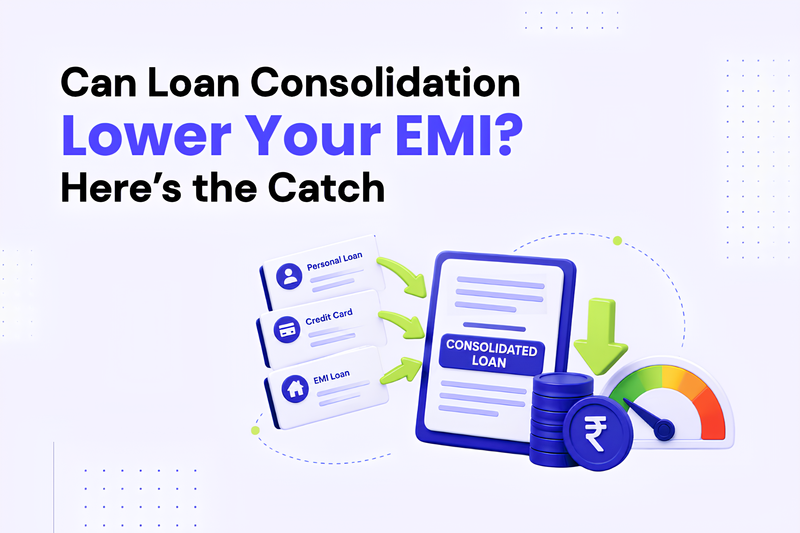
Loan consolidation, also called debt consolidation, uses one new loan to pay off several existing debts, such as credit card balances and personal loans. You are left with one loan, one EMI and one due date. Lenders such as SMFG India Credit and Tata Capital describe it this way.
In practice it does three things:
Merges many payments into one, so you track a single date.
Can change your interest rate. If the new loan is cheaper, you pay less interest.
Can change your structure. Revolving card debt becomes a fixed loan with an end date.
It does not reduce what you owe. Consolidation restructures debt, and it does not waive any of it.
Why the interest rate gap matters
IDFC FIRST Bank notes that credit card dues in India commonly carry 30% to 45% interest a year. Published personal loan rates for consolidation vary by lender: MyMudra cites 9.99% to 24%. These are lender-published ranges, not quotes, and your own rate depends on your income, credit score and lender.
IDFC FIRST Bank also highlights a structural point: paying only the minimum due on a card barely reduces the principal, while a fixed EMI reduces your balance every month.
A worked example
This is illustrative, using the standard EMI formula and rounded numbers. You owe ₹2,00,000 on cards at 36% a year. You consolidate into a loan at 15% a year for 24 months.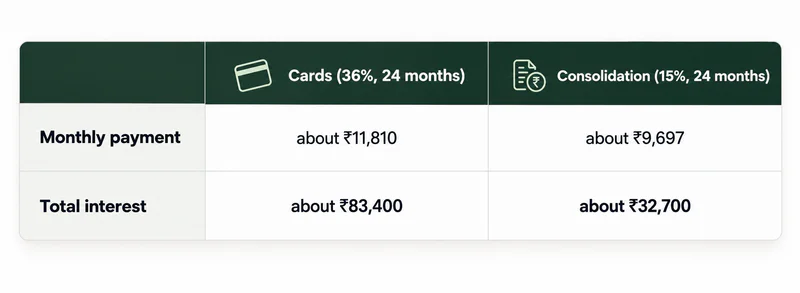
The saving is roughly ₹50,000 before any processing fee, which you should subtract. Now, if we stretch the same ₹2,00,000 at 15% over 48 months.

The EMI almost halves, but total interest more than doubles. It is the direct train again: if it is much slower, you spend far longer on it. A lower EMI is not the same as a lower cost, so always compare total repayment.
A lower EMI doesn't always mean a better deal. We can help you understand your debt and the options available before you make your next move.
Common ways to consolidate in India
Tata Capital lists three common methods:
Personal loan: unsecured, used to clear cards and other loans. Check the processing fee.
Balance transfer credit card: moves card dues to a new card, often at a promotional rate. Check what happens when that rate ends.
Home equity or other secured loan: often cheaper, but your asset is at risk if you cannot repay.
What the RBI rules mean
Consolidation means closing old loans early, so foreclosure rules matter. Under the RBI (Pre-payment Charges on Loans) Directions, 2025, for loans sanctioned or renewed on or after 1 January 2026:
Regulated lenders cannot charge prepayment penalties on floating-rate loans to individuals for non-business purposes, including personal loans.
This applies whatever the source of the prepayment money, with no minimum lock-in period.
On fixed-rate loans, lenders can still set prepayment charges, but they must disclose them upfront.
Before consolidating, check for each old loan whether it is floating or fixed and what the agreement says about foreclosure. Any exit fee belongs in your calculation.
What the data says about borrowers with many loans
TransUnion CIBIL found that in Q2 2023, 51% of consumers taking a small-ticket personal loan (under ₹50,000) already held more than four credit products, up from 17% in Q2 2019.
TransUnion CIBIL data reported in September 2026 shows credit access reaching 74% of India's eligible population, versus 35% in March 2017.
Juggling several EMIs is now common. Consolidating while you still pay on time is very different from consolidating after you have fallen behind.
How it affects your credit score
Possible short-term dip, because applying for a new loan involves a credit check.
Possible improvement, since clearing card balances lowers credit utilisation, which IDFC FIRST Bank says can support your score over time, and on-time EMIs build a positive record.
The trap: if you clear the cards and then spend on them again, you end up with the new loan plus fresh card debt.
One missed EMI on the new loan can undo the benefit quickly.
When consolidation makes sense
It tends to work when you have several high-interest debts, can qualify for a meaningfully lower rate, are still paying on time, have checked that total cost including fees is lower, and will stop adding new debt.
When it does not help
The new rate is not lower, so you are only rearranging debt.
You only stretch the tenure, as shown above.
You are already in default. Missed payments make approval harder and rates higher. Consolidation is not an escape from recovery calls or legal notices.
Your loans are already cheap. Home loans are usually far cheaper than personal loans, so moving them into a personal loan would raise your cost.
You would put an asset at risk for a small saving.
Consolidation isn't your only option. If repayments are already becoming difficult, understand the difference between debt consolidation, loan restructuring and settlement before deciding your next step.
If you are already struggling to repay
Consolidation is for people with breathing room. If you are facing missed EMIs, overdue payments or recovery pressure, the first step is understanding your position and options, not taking a bigger loan on worse terms.
Already falling behind on your EMIs? Credfix can help you understand your repayment options and take the next step towards getting your debt under control.
Final thoughts
Consolidation replaces several debts with one. Whether that helps depends on the rate, tenure, fees and your discipline afterwards. At the right time it can save real money and reduce stress. Done carelessly, it can raise your total cost or leave you with old debts plus a new one.
Frequently Asked Questions
What does loan consolidation do?
It uses one new loan to pay off multiple existing debts, giving you a single EMI and due date. It does not reduce the amount you owe.
Does consolidation always lower my interest rate?
No. It saves money only if the new rate is lower than what you were paying.
Will consolidation hurt my credit score?
There may be a small short-term dip from the credit check. Over time, lower utilisation and on-time EMIs can help, while missed payments hurt.
Is consolidation the same as loan settlement?
No. Consolidation repays your debts in full through a new loan. Settlement means negotiating to close a debt for less than what is owed.
Credfix
When debt feels overwhelming, we help you understand what comes next. Get practical guidance on missed EMIs, recovery calls, legal notices, settlement options, and your rights - explained simply, so you can make informed decisions.
Visit SiteEvery loan has a way out. Find yours.
Know your options. Take control.