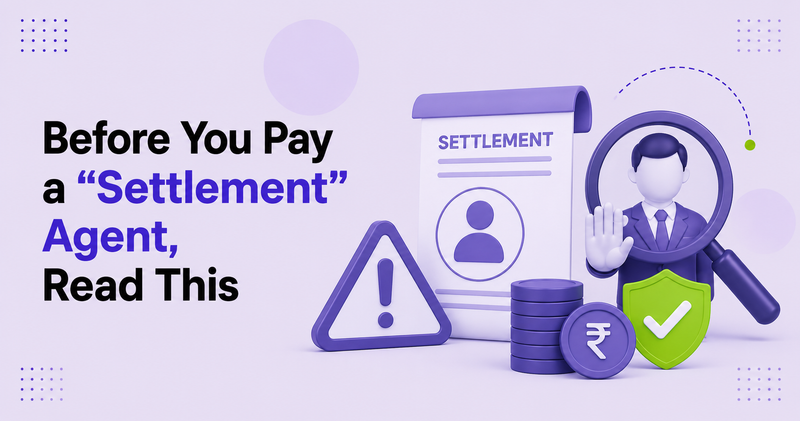
Before You Pay a "Settlement" Agent, Read This
A settlement offer looked real, until the "agent" vanished and the loan stayed active. Here's how to actually verify one...
It started with a phone call that felt like a lifeline.
A borrower we'll call Rohan had a personal loan that had slipped two payments behind. His phone had been buzzing with collection calls for weeks, so when an agent rang and said, "Pay us 30% today and we'll close the whole thing," it sounded less like a scam and more like a miracle. He transferred the money to the UPI ID the agent sent over WhatsApp. No paperwork. No letter. Just a screenshot promising the loan would be marked "settled" within 48 hours.
Three months later, the loan was still showing active. The penalties had kept compounding. And the agent's number no longer existed.
Not sure if your settlement offer is real? Verify it properly before you pay. Get expert guidance on the Credfix app.
Why this scam works so well
A real one-time settlement (OTS) and a fake one look almost identical from the borrower's side. Both involve a reduced payoff amount. Both promise the loan will be closed. Both often arrive when you're already stressed and want the problem gone as fast as possible. The Reserve Bank of India has flagged fake settlement offers over WhatsApp as one of the more common tactics used by people posing as recovery agents in the digital lending space, precisely because panic makes people skip the verification step they'd normally take for something this consequential.
What a real settlement actually requires
Under the RBI's Digital Lending Directions, which came into effect in stages through 2025, there are a few non-negotiable rules that any legitimate settlement has to follow:
Money only flows one way. All repayment, including a settlement, must go directly from your bank account to the lender's (the bank or NBFC) account. No lending app, agent, or "collection partner" is allowed to hold your money on the lender's behalf. If someone asks you to pay into a personal UPI ID or a third-party "recovery" account, that alone tells you the offer isn't real.
You get it in writing, on letterhead. A genuine settlement comes as a formal letter from the lender, not a WhatsApp message, stating the reduced amount, the payment deadline, and confirmation that the account will be reported as settled once paid.
There's a reference number you can verify independently. Call the lender's official customer care line, listed on their website or your original loan documents, not the number the agent gave you, and ask them to confirm the settlement reference number exists on their end.
Recovery agents have to be disclosed in advance. Lenders are required to tell you who their assigned recovery agent is before that agent makes contact. If someone calls claiming to represent your lender and you were never notified, that's a red flag worth acting on.
The part nobody explains: "settled" still costs you
Even a completely legitimate settlement isn't free of consequences, and this is the detail most borrowers only discover after the fact. A settlement gets reported to credit bureaus as "Settled," not "Closed," and the difference matters more than it sounds like it should:
Your credit score typically drops by 75 to 100 points, sometimes more, immediately after a settlement is reported.
The "Settled" tag stays visible on your credit report for up to 7 years from the date of settlement, even though the account itself is no longer active.
During those 7 years, other lenders can see it, and many will factor it into whether they approve you for a car loan, a credit card, or a home loan.
You can eventually upgrade "Settled" to "Closed" by paying the remaining outstanding amount later and formally disputing it with the bureau, a process that typically takes about 30 days once the lender confirms it.
None of this means settlement is the wrong call if you genuinely can't repay in full. It means it should be a deliberate decision made with the real numbers in front of you, not something you agree to on a panicked phone call.
A quick way to think about it
A real settlement is like signing a lease: paperwork, a signature, a document you can produce later if there's ever a dispute. A fake settlement is like handing someone cash for a lease they promise to send you "shortly." If you wouldn't sign a lease over WhatsApp with a stranger, don't settle a loan that way either.
Before you pay any settlement, do this
Get the offer in writing from the lender directly, not the agent who called you.
Call the lender's official number (found on their app or website, never the number on the offer itself) and confirm the settlement reference exists.
Confirm the payment destination is the lender's own bank account, not a personal UPI ID or third-party wallet.
Ask what status it will report as ("Settled" vs "Closed") and get that confirmation in writing too.
Keep every document. If the "Settled" status doesn't show up correctly later, you'll need proof of what you paid and what you were promised.
Loan trouble is stressful enough without also having to play detective on every call and message that comes your way. That's exactly the gap Credfix is built to close, giving you a clear, verified view of your loan status, settlement options, and credit impact, so you're never negotiating blind again.
This article provides general information about loan recovery and settlement in India and does not constitute legal or financial advice. For guidance specific to your situation, consult Credfix or a qualified legal or financial professional.
Credfix
When debt feels overwhelming, we help you understand what comes next. Get practical guidance on missed EMIs, recovery calls, legal notices, settlement options, and your rights - explained simply, so you can make informed decisions.
Visit SiteEvery loan has a way out. Find yours.
Know your options. Take control.